

One afternoon I was listening to music made by Aum Shinrikyo — the doomsday cult that released sarin in the Tokyo subway in 1995, killing fourteen people and injuring thousands.
Let me state where I stand. I have no patience for any group that deliberately harms people — least of all Aum, which killed fourteen with sarin in the subway. That is not forgivable. A crime is a crime. What follows examines it from a different angle.
With that said, here is the fact I have to report: the music works. The so-called astral music the cult made for meditation — cheap synthesizers, endless repetition, structures no label would keep — functions, unmistakably, as trance music. Thirty years on, played to a listener who despises everything the group stood for, the machinery still runs.
That discomfort was the doorway into a question I couldn't put down. Why does cult music work? What is it actually doing? And why, when I lined up the answers, did they start describing my weekends?
Designed to Alter
Two things explain the strange potency of Aum's recordings. Neither is talent in the usual sense.
The first is the production environment. This was music made outside the market. No deadlines, no A&R, no test audiences, no reason to trim the eleven-minute drone to a radio-friendly four. Everything a commercial process would sand off is still attached. In that sense it sits on the same shelf as outsider art: work whose strangeness survived because nobody with power over it cared about your attention span.
The second is intent. This music wasn't written to be good. It was written to be effective, a tool for altering consciousness, built for repetitive playback inside practices that already included sleep deprivation and, we now know, drugs. Asking whether it's well-made is like judging a hypnotist's script as literature. It was tuned for trance, so it produces trance. The only surprise is that the tuning holds even after the doctrine is stripped away.
Seen that way, Aum's tapes join a very old lineage: Gregorian chant, the Sufi dhikr, gamelan trance ceremonies, and — we'll get there — four-on-the-floor techno at brutal volume. Religious music has always been body-manipulation technology. Cult music misuses it.
The Discography of Belief
Once you start listening to cult discographies, a pattern emerges that beats any exposé: the music can't lie. Doctrine can be laundered for the public. A sound can't. Whatever the group was actually selling comes out in the genre.
Scientology made albums. Space Jazz (1982) was L. Ron Hubbard's soundtrack to his own novel: cutting-edge Fairlight, name musicians, the air of a vanity project with no budget ceiling. But the truly revealing artifact is "We Stand Tall" (1990), an internal anthem that later leaked. Soaring key changes, group vocals, the exact emotional grammar of a corporate awards ceremony or a soft-drink commercial. Nothing like mystical ecstasy.
Peoples Temple cut a gospel record, He's Able, in 1973, five years before Jonestown. It is, genuinely, a good gospel-soul album: tight band, powerful voices, real warmth. That's what makes it the heaviest listen in this whole field. The community's promise — belonging, dignity, interracial solidarity — was real enough to sing, and over nine hundred people followed that warmth to Guyana. Knowing the ending, the opening welcome is almost impossible to hear.
The Source Family, a 1970s Los Angeles commune, recorded psychedelic rock as morning ritual, their leader improvising over the band at dawn. Collectors prize those records today not as curiosities but as legitimately good free-form psych. And the Osho movement commissioned meditation music from Deuter, a first-rate ambient composer. Aum's project done competently, which is its own unsettling thought.
Line them up. Aum is trance induction. Scientology is corporate triumph. Peoples Temple is communal warmth. The Source Family is freeform abandon. Four groups, four genres. In every case, the music's genre is a more honest tell than anything the group said about itself. You can spin a doctrine for years; the sound gives it away in minutes.
The Machinery
Music is only one part of the belief-machine. Map the rest, and you can see where the music sits.
There's a useful division hiding in the logistics. Some influence tools are distributable: music, video, books. Things you can mail, broadcast, or stream to strangers. Others require enclosure: incense, lighting, sleep schedules, diet. You can't post a smell. Scent is neurologically privileged; it runs to the emotional brain more directly than any other sense, which is why nearly every religion burns something. But it only works on people already in the room. So the pattern: distributable media recruit; enclosure media retain and deepen. Aum's music was its outbound signal, sold in shops and played on streets. The physiological program waited inside.
And the physiological layer is the strong one. Sleep deprivation dulls exactly the faculties you'd need to argue back; critical thinking lives in the prefrontal cortex, the first thing exhaustion powers down. Controlled overbreathing produces tingling, euphoria, dissociation on demand; certain "dynamic meditations" are, mechanically, guided hyperventilation. Restricted diets alter mood and clarity. Music matters here as a multiplier: a drone that's mildly hypnotic on a rested listener is overwhelming on someone forty-eight hours awake. The tapes I heard were designed for people in that state. I only got the carrier wave.
The sociology delivers the real anticlimax, and it's worth stating because it dismantles the horror-movie version. Decades of research on who actually joins these groups keep finding the same thing. The strongest predictor isn't doctrine, charisma, or music. It's friendship: whether people you trust are already inside. Classic fieldwork found conversion followed social bonds far more than belief. Later studies found that of the people who attended one famous new religion's recruitment workshops, only about one in ten joined, and most of those left of their own accord within a couple of years. The irresistible-brainwashing-machine image doesn't survive contact with the data. The outer layer of any such group runs on the most ordinary force there is: belonging. The coercion is reserved for the core, and the outer layer rarely sees it.
Hold that architecture in mind. An open, warm periphery running on friendship. A sealed core running on physiology. And music carrying the signal between them.
The Club Checklist
Somewhere in the research, a stray thought moved in and stayed: this is describing club culture.
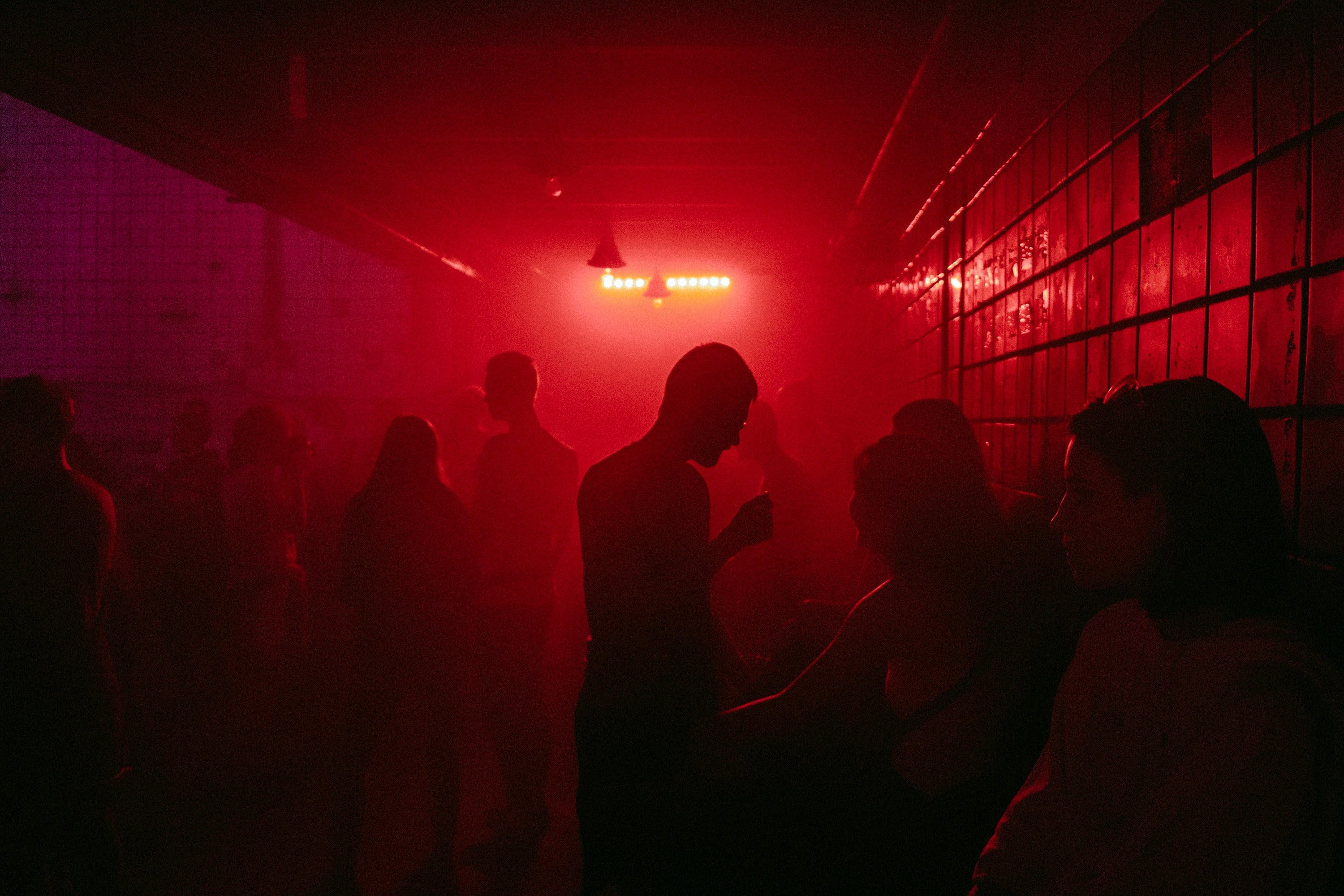
Run the checklist against a serious techno weekend. Berlin is the reference implementation.
Sleep deprivation: Friday midnight to Monday morning.
Repetitive audio engineered for altered states: that's simply the definition of techno.
Chemical initiation.
Windowless rooms, no clocks: standard architecture.
Information sealing: the camera stickers over your phone lenses.
In-group language and thought-terminating clichés: "if you know, you know."
Costly signaling: this one needs a paragraph.
The door at Berghain is famous for rejecting people without explanation, for being unbuyable, for standards nobody can state. As user experience, it's absurd. As social technology, it's precision-engineered, and it's the same mechanism documented in nineteenth-century religious communes, where researchers found that the stricter the demands, the longer the commune survived. High entry costs filter out the uncommitted and make everyone who paid them value the inside more. The bouncer isn't gatekeeping a bar. He's administering a sacrament of costly signaling, and it works exactly as well as it did on the Shakers.
Even the architecture rhymes, with one beautiful inversion. Real sanctity is usually bought with time; a cathedral's authority is eight hundred years of accumulation, which is why new religions in prefab buildings always feel faintly fraudulent, and why Aum's compounds were, tellingly, just sheds with the windows managed. Techno squatted the ruins of the twentieth century. A power station, a bank vault, a factory floor. Spaces that arrive pre-loaded with eighty years of gravity. The ceiling height at Berghain is not a set. That's the one line on the checklist where the club didn't imitate the cult. It outbid it.
The Two Empty Slots
So is the club a cult? No. And the two ways it isn't are the most precise definition of "cult" I know.
Scholars largely dropped the word "cult" because no doctrinal test could separate a cult from a religion; every creed sounds strange from outside. What survived scrutiny was a behavioral measure: the cost of leaving. That's the modern frame, the high-demand group, defined not by what it believes but by what exit costs. And there, the club diverges completely. Monday morning, the doors open, and you leave. Nobody calls. Nobody shuns you. Your family was never involved. The door, the darkness, the seventy-two hours: the whole structure evaporates on contact with Monday. Free exit isn't a detail. It's the load-bearing difference.
The second empty slot: there's no one at the top. Techno, at its best, has been almost doctrinally anti-guru. Masked producers, faceless collectives, no VIP room in the temple. The one chair every high-demand group must fill, the scene deliberately leaves vacant. A religion of the dance floor with an empty altar.
Then history added its punchline. In 2024, Berlin's techno culture was added to Germany's national inventory of intangible cultural heritage, by the German UNESCO Commission — the national list, not UNESCO's international one. And in 2021 the Bundestag resolved to treat clubs as cultural venues rather than mere entertainment. Which is to say: the state canonized it. This is exactly the path by which new religions become old ones. Survive long enough, grow a harmless outer congregation, and the institutions that once raided you start preserving you. In Tbilisi, when police raided the club Bassiani in 2018, thousands danced in front of parliament until a government minister apologized. A scene negotiating with state power much the way a church once did.
One refinement, because it matters. Old religions didn't survive by softening their cores. They survived by growing a costless periphery around a costly core: the Christmas-only churchgoer orbiting the monastery. The club reproduces that anatomy exactly. Tourists on the main floor, and the people still there Monday at noon, for whom it's closer to practice than entertainment. Periphery plus core, with free exit. It's the cult's architecture, run in safe mode.
Tokyo Coda
What we buy on a dance floor, it turns out, is the oldest product there is. Transcendence through rhythm, darkness, and other people's bodies — the technology religions spent millennia refining — with the two dangerous parts left out. No one owns the altar, and the exit is free.
That might be the most Tokyo-compatible religion I can think of.
If you want the rooms themselves, where to hear this city at 4 a.m., that's part of what Map & Tips is for. And subscribing gets you every essay like this one.