

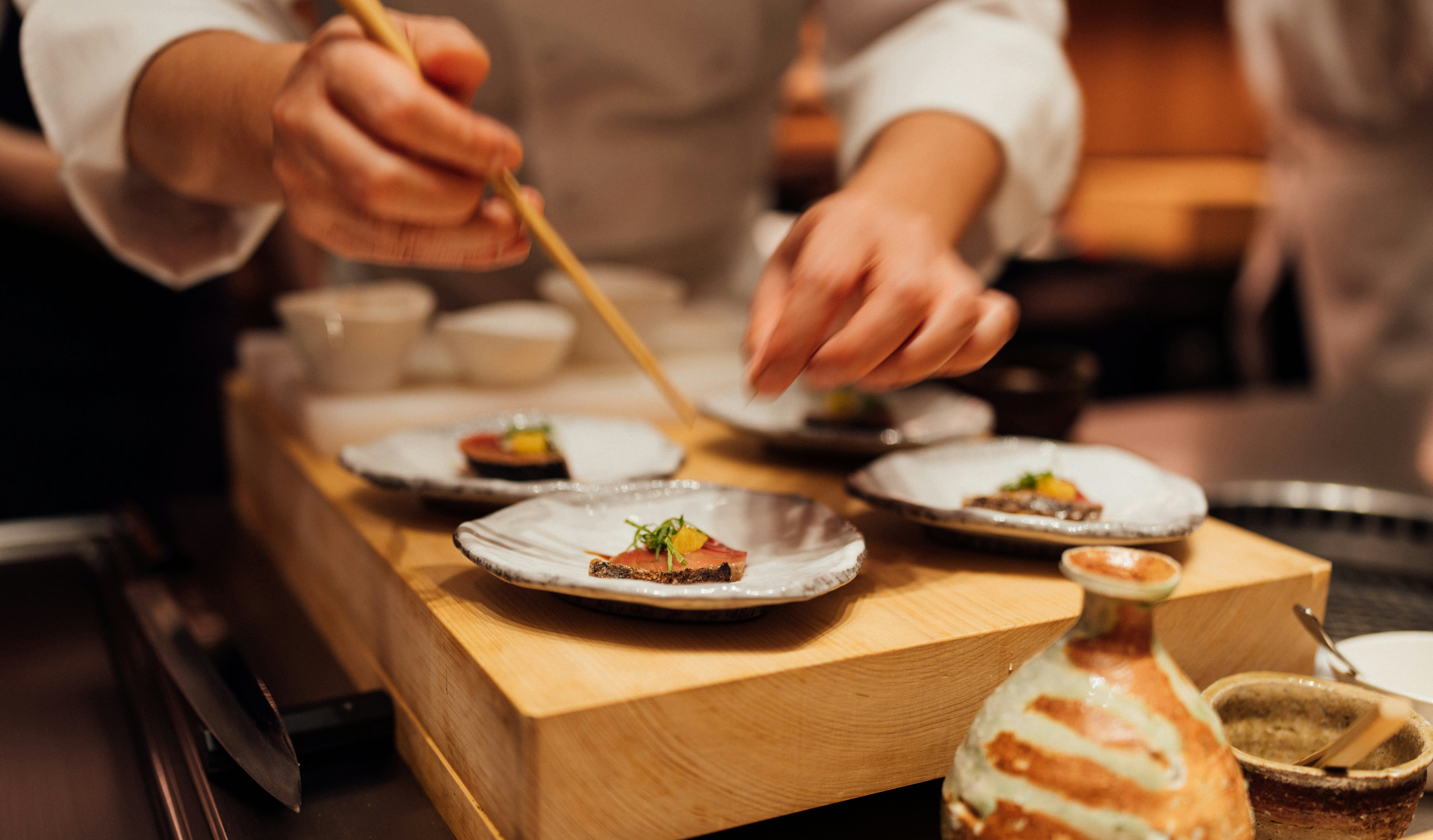
Tokyo tastes good wherever you go. That isn't hype; it's close to a structural fact. The city has led the world in Michelin stars for eighteen years running, with 170 starred restaurants in 2025, ahead of Paris's 142. But that's the least interesting number here. Stars measure the ceiling. Tokyo's real feat is the floor: even the cheapest places are good.
So the question worth asking isn't where to eat in Japan, or Tokyo. It's why Japan is so reliably, unreasonably good at food. The answer is twelve hundred years old, and it was never really about food.
The Average, Not the Peak
Every food city has a peak. Lima has its tasting menus, Copenhagen its foraged everything, and New York can buy almost anything with money — love excepted. What Tokyo has that no other city does is an average so high you could fall asleep on it.
A 500-yen (about $3) beef bowl is good. A 1,000-yen (about $7) bowl of ramen chosen at random is usually very good. The mid-range izakaya, the department-store basement, the highway rest stop: all of it clears a bar that would make a restaurant respectable in most Western capitals. The quality doesn't fade as the price drops.
Two forces hold that floor up.
The first: craftsmanship here was never reserved for craftsmen. In most countries, obsessive technique belongs to a small guild of top chefs, and everyday food gets everyday effort. In Japan the ethic spread everywhere. The part-timer calibrating the tempura station. The chain-store manual specifying the seconds of a noodle's bath. Perfecting one small thing, and then perfecting it again, is treated less like ambition than basic decency.
The second is the customer. Japanese diners may have the sharpest palates on earth. They notice the small difference — how the rice was cooked, how clear the broth runs — and they keep going back to the good ones. Cheap isn't an excuse here; it's its own category with its own standards. Word travels fast, about the good places and the bad alike. Put the two together, and the good places are the ones that naturally last.
The sharpness itself is the interesting part. It isn't natural. It was built, by a law almost nobody remembers.
The Ban
In 675 CE, Emperor Tenmu issued an edict banning the eating of meat: cattle, horses, dogs, monkeys, and chickens.
It's tempting to read this as deep religious feeling. It was closer to policy. Japan was assembling itself into a state, and Buddhism was the statecraft of the moment. Adopting its prohibition on killing signaled — to the court, and pointedly to Tang China (present-day China) — that this was a civilized, righteous nation. The ban was, in large part, diplomatic branding.
It was also economics. Cattle and horses were the tractors and trucks of the seventh century. Eat your ox and you've eaten your farm. Protecting draft animals protected the rice economy, the actual foundation of state power. "Don't eat the infrastructure" is not a spiritual teaching.
But laws have afterlives their authors never plan. Over centuries, the edict fused with the Shinto instinct that blood is pollution, kegare, and hardened from regulation into taboo. Eating four-legged animals became not illegal so much as unclean, unthinkable. What began as seventh-century industrial policy lasted until the Meiji government formally rehabilitated meat in 1872 and the emperor himself made a show of eating beef.
The Loopholes
Here's the thing about a 1,200-year ban: people never stop wanting meat. What Japan produced instead was twelve centuries of magnificent cheating.
Rabbits were reclassified as birds — long ears, they hop, therefore bird — which is why, to this day, rabbits in Japanese are counted with the bird counter: one wa, two wa. Whales and dolphins, being in the ocean, were filed under fish and eaten with enthusiasm. Wild boar became yama-kujira, "mountain whale," a phrase that does an impressive amount of legal work in four syllables. Venison became momiji, maple leaves; horse became sakura, cherry blossom; and by the Edo period there were specialist restaurants serving all of it under the sturdy alibi of kusuri-gui, "eating as medicine." Not dinner. Treatment.
Chicken, meanwhile, stayed taboo longer than most: the rooster announced the dawn and was considered sacred. A civilization that had talked itself into whale-as-fish drew the line at the bird in the yard.
For twelve centuries, Japan quietly built loophole upon loophole around its own law. That accumulation is what raised an exceptionally refined palate.
Umami as Engineering
Take away meat, and a problem remains: how do you make food satisfying without fat and flesh?
Japan's answer was to go small. Having set aside the obvious, cooks turned to the microscopic: the glutamates in kombu (dried kelp), the inosinates in katsuobushi (dried, shaved bonito — a fish), the guanylates in dried shiitake (a mushroom). Dashi is the stock built from these.
And the technique went further. Combine glutamate with inosinate and the perceived intensity doesn't add, it multiplies. Umami synergy is textbook food chemistry now; Japanese cooks worked it out empirically, as a whole population, centuries before anyone could explain why. Add the fermented seasonings — soy sauce, miso, mirin — and you have a cuisine that engineers depth where others reach for meat.
Shinto did its part. In a worldview where yaoyorozu no kami, eight million gods, inhabit every natural thing, an ingredient isn't raw material; it's a guest. The cook's job becomes not transformation but revelation: draw out the ingredient's strengths to the fullest.
The philosophy is clearest by comparison. Much of Asia cooks by addition: the wok's fire, the chili's heat, the market's momentum. It's thrilling, generous, alive. Japan cooks mostly by subtraction, drawing out the best of what the ingredient already is: control the temperature, control the water, strip away every stray note until only the signal is left. The care shows in the details — a takoyaki nudged around the hot iron so the heat reaches it evenly, or the exact moisture a soba shop watches over.
The Inherited Palate
Once the constraint lifted, that trained palate turned outward. Japan made omurice from the Western omelet, put the cutlet and curry of two different empires on one plate, and studied Chinese noodle soup closely, adding its own interpretation to create ramen. The same reflex that once perfected dashi now elevates whatever it touches: French pastry, Neapolitan pizza, third-wave coffee.
How to Eat Well Here — Price and Prestige Aside
The places I actually go, and the know-how for using this city like a local, live in Map & Tips — a full field guide with a curated Google Map, included only with the annual membership. Check the free samples, then go, and taste it for yourself.