

In Japan, the traditional performing arts are protected by the state and receive financial support. For some of them, succession within a family is the rule. And precisely because of that, you also hear of sexual abuse and harassment inside them. This piece first looks at the traditional performing arts, which the state has designated for preservation, through budget documents and the dates in the law. It also compares contemporary art and music. Then it asks why Korea and France, with their larger culture budgets, keep updating their systems while Japan’s goes un-updated. Finally, it looks at what happens while the system stays un-updated.
The culture budget is small, but traditional arts are comparatively well looked after
Japan’s culture budget is small. The Agency for Cultural Affairs has ¥107.3 billion for FY2026 — 0.09% of the national general-account budget of ¥122.3 trillion.
Support for traditional arts isn’t only cash
The cash a Living National Treasure (an individually certified holder of an Important Intangible Cultural Property) receives from the state:
A special grant from the Agency for Cultural Affairs
As of July 2026; 4 more added by that month’s council recommendation, making 110
Of these, the performing arts account for 38 designations and 55 holders
What is generous, on the other hand, is buildings and institutions:
The National Theatre, the National Noh Theatre, the National Bunraku Theatre, the National Engei Hall
Permanent venues dedicated to traditional performing arts, built and run by the state
Nothing equivalent exists for contemporary art or contemporary music
The National Theatre’s training programme
Kabuki, bunraku and noh apprentices are trained by the state
An annual slate of performances
A contemporary artist applies to a competitive grant and is turned down; for traditional performing arts, the opportunity to perform is itself supplied as an institution
Traditional arts, contemporary art and contemporary music compared, inside one budget document
Open Japan’s Agency for Cultural Affairs’ FY2026 budget and the lines read:
Traditional performing arts
¥679 million + the running costs of the national theatres (see the notes below)
¥679 million is the line for transmission and public performance of intangible cultural properties (FY2026 budget). Craft techniques are included
Breakdown: holder bodies ¥380 million + Living National Treasure grants ¥252 million + public performance ¥47 million
Note: the cost of building and running the national theatres is not included in the above. Separately, the Japan Arts Council, which runs them, receives an operating grant of ¥11.92 billion from the state (FY2026 plan budget)
Its programme spending: the National Theatre ¥2.34 billion, the National Theatre Okinawa ¥668 million, the New National Theatre ¥4.26 billion
The grant also covers contemporary stage arts at the New National Theatre, so not all of it goes to traditional arts
Note: rebuilding the National Theatre takes a further ¥1.6 billion on top of the above (FY2026 budget)
Contemporary art
About ¥0.5 billion
The total of 3 programmes for art
Global expansion of Japanese art: ¥137 million (support for showing at overseas art fairs and the like)
A new art platform originating in Japan: ¥300 million (building art fairs and similar venues at home)
Art-ecosystem groundwork: ¥61 million (the infrastructure of the art market)
The first 2 sit in the “global development of culture and the arts” line, which comes to about ¥0.9 billion in all. The rest of it is not art
A hub built around international events: ¥130 million (art combined with music; popular music)
International careers for future top artists: ¥128 million (young artists abroad, pop culture included)
Global expansion of print culture: ¥165 million (translation, literature abroad)
Note: the ¥8.46 billion operating grant to the National Museum of Art (FY2026 budget) is not included in the above. It pays for running the museums as a whole, not for contemporary art alone
Contemporary music
No line of its own
Folded into the ¥8.7 billion “comprehensive support for performing arts,” not an independent line
But inside “global development of culture and the arts,” 2 programmes include popular music: support for young artists’ international careers ¥128 million, and a hub combining art and music ¥130 million
The latest move (the FY2027 request, before the government has trimmed it)
Traditional performing arts: ¥817 million, +20%↗︎
Contemporary art: about ¥0.5 billion, unchanged
All 3 programmes for art are held flat (¥137 million, ¥300 million, ¥61 million)
The whole “global development of culture and the arts” line goes from ¥867 million to ¥1.07 billion, +23%↗︎. The increase is in 2 programmes that are not art
Global expansion of print culture: ¥165 million → ¥308 million
A hub built around international events (art combined with music; popular music): ¥130 million → ¥190 million
Note: not counted as contemporary art, but the operating grant to the National Museum of Art goes from ¥8.46 billion to ¥10.56 billion, +25%↗︎
Contemporary music: still no line of its own
Operating grant to the Japan Arts Council: ¥13.84 billion, +16%↗︎ (¥11.92 billion in FY2026)
Rebuilding the National Theatre: ¥2.4 billion
On these lines alone, traditional performing arts get ¥679 million and contemporary art about ¥0.5 billion, so the gap is small. The gap opens up because the national theatres that support the traditional arts are paid for under other lines.
Traditional performing arts have their own line. Contemporary art has its own line. But contemporary music doesn’t. Electronic music, clubs and the like have no category at all. You can see “not counted” in the table of contents alone.
How the genres to be preserved were decided: a history
When, and by whom, was the list of Important Intangible Cultural Properties (the performing arts the state designates for preservation) drawn up? The dates run like this:
1897 Ancient Shrines and Temples Preservation Law — the first law protecting buildings and treasures of shrines and temples. Objects only
1929 National Treasures Preservation Law — extends to buildings in private and municipal hands. Still objects only
1950 Cultural Properties Protection Law — for the first time, the “techniques” of performing arts and crafts enter the law as “intangible cultural properties”
1954 Amendment — creates the designation of Important Intangible Cultural Properties and the certification of holders (Living National Treasures)
1955 First designations: gagaku court music, bunraku puppet theatre (dates in this list from the national register)
1957 Noh
1965 Kabuki
1972 Kumi odori (Okinawan dance-drama)
The core of what Japan calls a national asset on stage — 5 arts: gagaku, bunraku, noh, kabuki, kumi odori — was set in the 22 years between 1950 and 1972. The national theatres and the training programmes were built around those 5.
Names have been added since — but mostly fields attached to those 5: gidayū-bushi narrative music (1980), tokiwazu-bushi (1981), Ryukyuan dance (2009), Kyoto-style dance (2015). From outside them, very few got in, classical rakugo storytelling (1995) among them. The list moves to certify a successor to a holder who has died, not to admit a new genre.
Not undervaluation. Sorting. And the core has not changed in half a century.
Comparing budgets with other countries
Japan’s system is often called bureaucratic. So what do countries with larger culture budgets do with the same question? Here are 2: South Korea, whose system closely resembles Japan’s, and France, which has a title for craftspeople, the Maître d’art, inspired by Japan’s Living National Treasures.
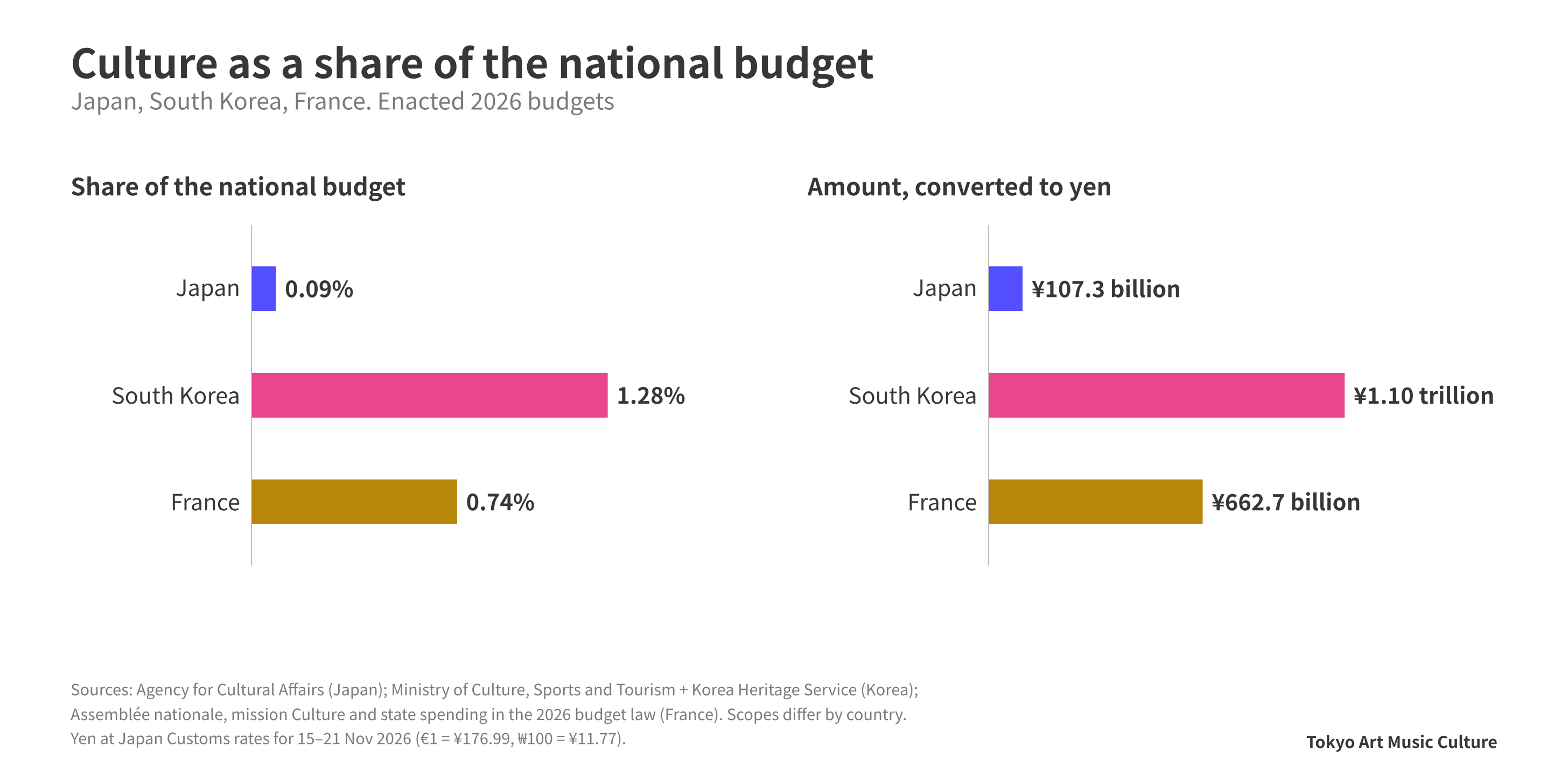
Culture as a share of the national budget is as follows.
Note: enacted 2026 budgets for all 3. Japan’s general account, Korea’s total expenditure, France’s state spending — the scopes differ. Korea’s culture budget is the culture ministry plus the Korea Heritage Service, and the heritage, contemporary-art and contemporary-music shares below all use that combined total as the denominator Note: amounts are converted to yen, with the local currency in brackets, at Japan Customs rates for 15–21 Nov 2026 (€1 = ¥176.99, ₩100 = ¥11.77)
Japan
South Korea
1.28% = culture budget ¥1.10 trillion (₩9.35 trillion) ÷ total expenditure ¥85.7 trillion (₩727.9 trillion)
France
0.74% = the culture ministry’s “Culture” budget ¥662.7 billion (€3.74 billion) ÷ state spending ¥89.0 trillion (€503 billion)
The latest move (2027 budget plans; none is enacted yet)
Japan: the agency’s request of ¥233.5 billion ← ¥107.3 billion in FY2026
A ministry request, before the government has trimmed it. The government’s draft is normally settled in late December
South Korea: culture ministry ¥1.13 trillion (₩9.63 trillion) ← ¥924.6 billion (₩7.86 trillion) in 2026, +22.6%↗︎
Korea Heritage Service ¥195.9 billion (₩1.66 trillion) ← ¥176.2 billion (₩1.50 trillion) in 2026, +11.2%↗︎
Government proposal, before the National Assembly
France: the ministry’s “Culture” budget ¥645.9 billion (€3.65 billion) ← ¥662.7 billion (€3.74 billion) in 2026, −2.55%↘︎
Government bill, before parliament
The gap in culture spending per person
Note: from a FY2023 joint study for the Agency for Cultural Affairs. These are 2023 initial budgets, so both the year and the scope differ from the 2026 figures above (France here is the whole ministry). Converted to yen at Japan Customs rates for 29 Oct–4 Nov 2023. This FY2023 edition is the latest with a single table that puts the countries side by side on one method; the FY2024 and FY2025 editions have country chapters only
Japan: ¥899 (culture spending ¥111.7 billion)
South Korea: ¥9,630 (culture spending ¥495.4 billion, ₩4.48 trillion)
France: ¥9,812 (culture spending ¥667.6 billion, €4.225 billion)
Korea and France each spend about 11 times what Japan does. In the FY2025 edition, Korea’s 2025 figure is ¥11,202 (₩106,079) per person, on a revised method that adds special accounts and funds. Even allowing for the recent weakness of the yen, that is an enormous gap.
Each genre's share of the culture budget
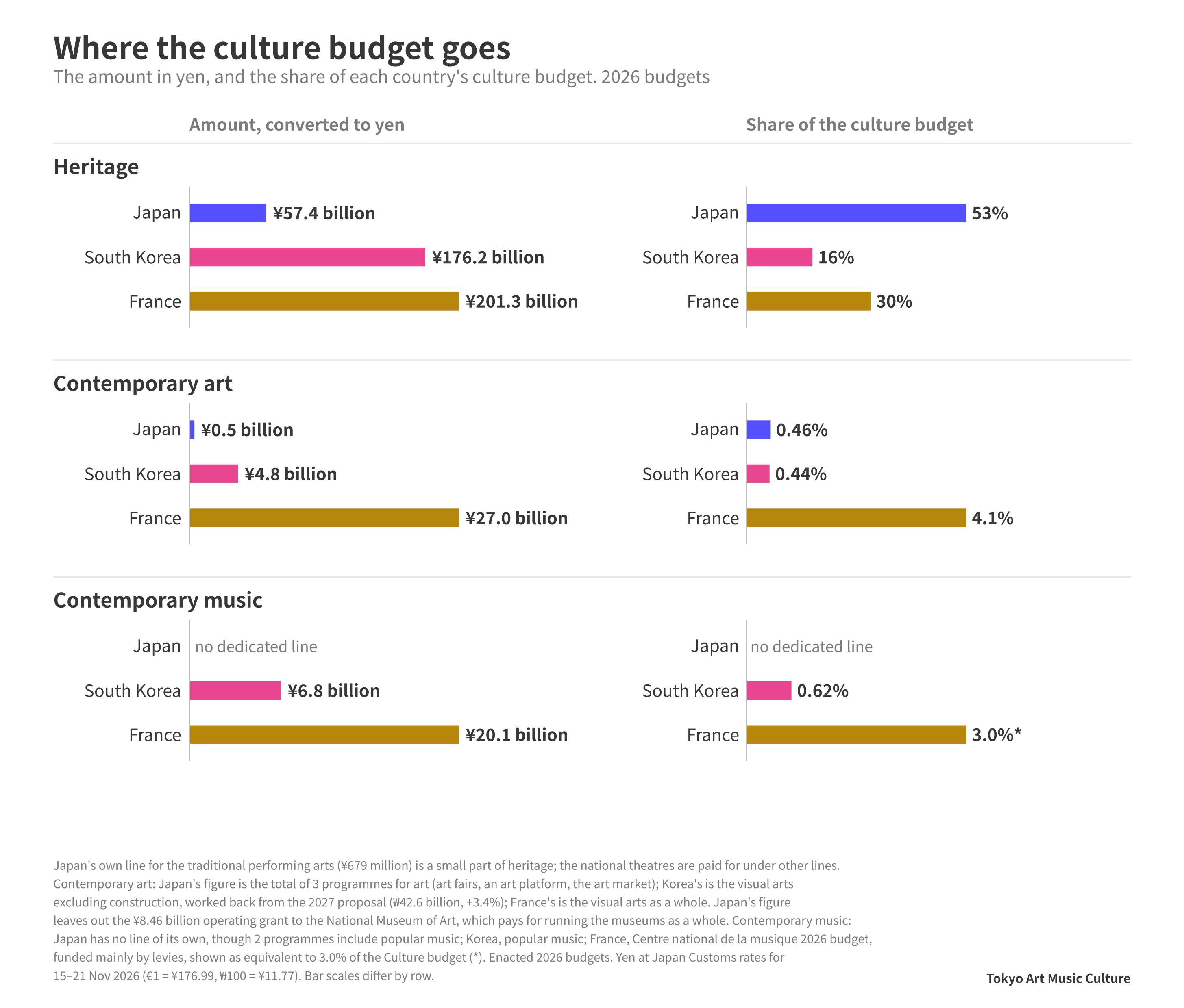
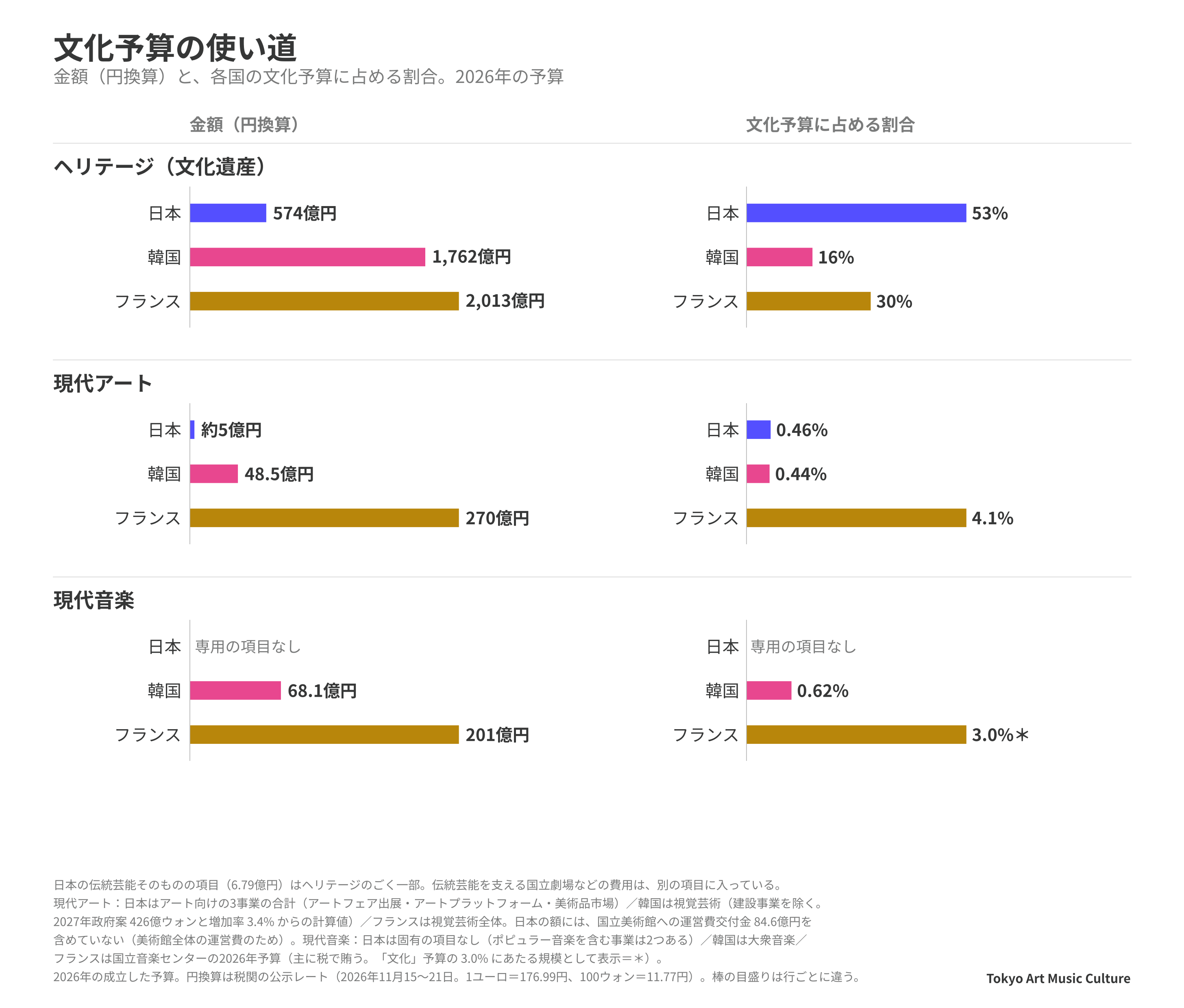
The share of the culture budget allotted to “heritage”
Note: enacted 2026 budgets. No country has a traditional-arts line, but every country has a heritage line. Most of it is buildings and sites, with staged traditional arts a small fraction.
Japan
53% = heritage preservation ¥57.4 billion ÷ agency ¥107.3 billion
Of which intangible cultural properties (traditional performing arts and craft techniques): 0.63% = ¥679 million ÷ ¥107.3 billion (0.0006% of the general account)
The latest move: the FY2027 request is ¥93.6 billion
South Korea
16% = Korea Heritage Service ¥176.2 billion (₩1.50 trillion) ÷ culture budget ¥1.10 trillion (₩9.35 trillion)
Of which “natural and intangible heritage” (which includes the performing arts): 0.012% = ¥10.7 billion (₩90.6 billion) ÷ total expenditure ¥85.7 trillion (₩727.9 trillion)
France
30% = the “Patrimoines” programme ¥201.3 billion (€1.14 billion) ÷ the ministry’s “Culture” budget ¥662.7 billion (€3.74 billion)
The performing arts sit under “Création” (¥176.6 billion, €998 million), not heritage. There is no traditional-arts-only figure
The share of the culture budget allotted to “contemporary art”
Note: enacted 2026 budgets. The scope differs by country. Japan’s figure is the total of 3 programmes for art; Korea’s and France’s cover the visual arts as a whole (Korea’s is creation, distribution and audience programmes, construction excluded). National museums are not in any of the 3 figures
Japan
0.46% = contemporary art about ¥0.5 billion ÷ agency ¥107.3 billion
The total of 3 programmes: support for showing at overseas art fairs and the like ¥137 million + building an art platform in Japan ¥300 million + groundwork for the art market ¥61 million
South Korea
0.44% = visual arts about ¥4.85 billion (about ₩41.2 billion) ÷ culture budget ¥1.10 trillion (₩9.35 trillion)
About ₩41.2 billion is the 2026 amount worked back from the 2027 proposal of ₩42.6 billion and its 3.4% increase
The latest move: the 2027 proposal is ¥5.01 billion (₩42.6 billion); including construction of cultural facilities, ¥11.89 billion (₩101 billion). Separately, the National Museum of Modern and Contemporary Art has ¥9.07 billion (₩77.1 billion)
France
4.1% = visual arts ¥27.0 billion (€152 million) ÷ the ministry’s “Culture” budget ¥662.7 billion (€3.74 billion)
The latest move: the 2027 bill has ¥27.6 billion (€156 million)
The 2026 budget for contemporary art is about ¥0.5 billion in Japan, about ¥4.85 billion in Korea and ¥27.0 billion in France. As a share, Japan and Korea are about level, but in money Korea spends about 10 times what Japan does, and France about 54 times.
The share of the culture budget allotted to “contemporary music”
Note: 2026 budgets. Popular music, including indie
Japan
No dedicated line
The agency’s budget document has no item of its own for contemporary music
This does not mean ¥0. Some music is covered inside general performing-arts grants, and 2 global-expansion programmes include popular music (support for young artists’ international careers ¥128 million; a hub combining art and music ¥130 million)
South Korea
0.62% = popular music ¥6.81 billion (₩57.9 billion) ÷ culture budget ¥1.10 trillion (₩9.35 trillion)
The latest move: the 2027 proposal is ¥9.44 billion (₩80.2 billion), +38.5%↗︎
Of which ¥1.88 billion (₩16 billion) is new money for indie music: an indie music hub ¥940 million (₩8 billion), regional indie festivals ¥350 million (₩3 billion), and more
France
¥20.1 billion (€113.4 million), outside the ministry’s budget
What the Centre national de la musique (CNM) pays out in support to the music sector. It covers all music, classical included
The CNM’s total budget is ¥23.5 billion (€133 million). The state subsidy is ¥3.54 billion (€20 million); most of the rest comes from levies on tickets and streaming
Set against the ministry’s “Culture” budget of ¥662.7 billion (€3.74 billion), that is equivalent to 3.0%
The CNM’s 2027 budget has not been published yet
5 things follow. Japan’s culture budget is, as a share, about 1/15 of Korea’s and about 1/8 of France’s. Within that small budget, Japan sends a larger share to heritage than either. The share going to contemporary art is 0.46% in Japan, 0.44% in Korea and 4.1% in France. For contemporary music, Korea and France each have a dedicated line with a figure on it, and Japan has no such line. And the cash that goes directly to the traditional performing arts is, in Japan, about 1/180,000 of the national budget. Add the ¥11.92 billion operating grant to the body that runs the national theatres (which also covers contemporary stage arts) and it is still about 1/10,000. In Korea, the combined natural-and-intangible-heritage line is about 1/8,000. France has no traditional-arts-only figure.
Comparing systems with other countries
South Korea: began with a system much like Japan’s, and keeps widening the list
The mechanics are much like Japan’s
The way its 1962 Cultural Heritage Protection Act operates resembles Japan’s 1954 amendment, institutional historians write
The same research adds that it was drafted in a different context and for a different purpose
The list keeps growing
Designated items: 31 (1964) → 128 (2013)
In January 2026, surveys opened on 7 more (a farming song, Buddhist funeral rites, children’s games like top-spinning, the customs of wild-ginseng gatherers)
Designation without a holder is possible
The law was amended in 2014
In 2015 the folk song Arirang became “the first intangible cultural property with no holder”
Certification isn’t permanent
It is cancelled at a holder’s death
An unfit holder can be struck off
Cash: ₩1.5 million a month per holder
As of 2023
Japan’s ¥2 million a year works out to about ¥170,000 a month
Conclusion: Korea updates the list as a register of practices the public shares, not of particular people’s status
France: keeps an inventory, but no list that it designates and funds
There is an inventory of intangible heritage: a national inventory begun in 2008 that includes performing arts such as music and dance
But being on it gives no right to a subsidy
Craftspeople get a title: Maître d’art, created by the Ministry of Culture in 1994, inspired, the ministry says, by Japan’s system by way of UNESCO’s Living Human Treasures programme (1993, proposed by Korea)
More than 149 people so far, across 100 specialties
Each commits to 3 years of passing the skill to 1 trainee
Performers are supported by unemployment insurance, not a title: the intermittents du spectacle regime, built for intermittent work on stage and screen
Condition: work 507 hours in 12 months and you are covered for the next 12
Scale: in 2025 an average of 141,000 people a month were covered, and it paid out €1.89 billion
Genre doesn’t enter into it: a double-bass player and a live techno act on an employment contract are in the same scheme
Conclusion: the state doesn’t decide what to protect; it insures whether you can keep working as a performer
Japan: the system doesn’t update
Korea, whose system closely resembles Japan’s, and France, which has a title for craftspeople, the Maître d’art, inspired by Japan’s Living National Treasures, have both kept revising. Why doesn’t Japan move? Reading the texts of the system, there are 3 reasons.
Reason 1: the entry criterion is authority as art
The designation criteria for an Important Intangible Cultural Property in the performing arts are “of especially high artistic value” or “of especially important standing in the history of the performing arts”
So from the start the criterion asks whether something carries authority as art — a posture that reads like the government’s own prejudice — not whether the public practises it
Korea rewrote its law in 2014 to let Arirang in. Japan’s criterion still carries the 1954 wording
Reason 2: new things are put in a separate category
The 1975 amendment: festivals and folk performing arts went into “intangible folk cultural properties,” a separate category with no holders
The 2021 amendment: a lighter tier, “registered” intangible cultural properties, was created for “lifestyle culture” such as calligraphy and food. Calligraphy was the first recommendation, in October 2021
So Japan does update. But new things go into separate categories, and the list of Important Intangible Cultural Properties itself — the one that comes with national theatres and training programmes — doesn’t change
Reason 3: the grant is a flat sum, and the headcount is capped
The Living National Treasure grant is a flat ¥2 million a year, and the budget allows for at most 126 holders (126 = budget ¥252 million ÷ ¥2 million, FY2026). Until FY2025 it was 116
With a fixed headcount, the list moves by certifying a successor to someone who has died, not by adding a genre
Example: the nagauta percussion designation lapsed in February 2026 when its holder died, and returned in July when a successor was certified
The 3 side by side
All 3 have something equivalent to a Living National Treasure (Korea certifies holders; France has the Maître d’art title for crafts)
South Korea: keeps extending the list
France: instead of a list, supports performers as workers
Japan: attached national theatres and training to the 5 arts it chose by 1972, and hasn’t changed them
Why Japan’s system doesn’t get updated
A system doesn’t move by itself. When the list or the scheme moved in Korea and France, it was performers who moved it. In Japan, people in genres not designated as Important Intangible Cultural Properties are weak in both bargaining power and solidarity, and the holder bodies the state certifies in the traditional arts were set up to match the designation.
France: performers have defended the scheme by striking
The intermittent regime is less something the state granted than something performers have kept defending
June 2003: employers’ federations and 3 unions (CFDT, CGC, CFTC) signed a protocol tightening benefits (the 507-hour window cut from 12 months to 10–10.5, benefit duration from 12 months to 8)
The CGT union refused to sign → the big summer festivals, Avignon, Aix, Marseille and Montpellier Danse among them, were cancelled
In June 2014 a new crisis broke out over an agreement signed that March. The scheme’s terms have been rewritten each time through negotiation and protest
South Korea: events and voices on the ground first, law second
January 2011: a young screenwriter died in poverty → that November the Artists’ Welfare Act (nicknamed the “Choi Go-eun law”) passed → in force the following November
December 2020: an employment-insurance scheme for artists opened and enrolled 95,000 people in its first year
Arirang’s designation (2015): after the 2012 UNESCO listing there was a public call for the state to designate it, and the law was changed
Japan, genres not designated as Important Intangible Cultural Properties: weak bargaining power, no procedure for applying, and weak solidarity across the field
Geidankyo, the federation of performers’ associations
Founded 1965, 70 member bodies
Proposed accident insurance for entertainment workers in 2002 → realised in 2021 (19 years)
The Japan Musicians’ Union
Asks for joint bargaining on minimum fees
The other side refuses, citing antitrust law
How performers work (2023 survey)
About 80% work as individuals
Over 60% earn under ¥3 million a year
No procedure for applying for designation
Japan: an expert panel of the Council for Cultural Affairs investigates, and the minister designates on the council’s report. The agency’s own paper states that it “does not use an application or nomination system”
Japan, genres not designated as Important Intangible Cultural Properties: hard to connect sideways, and little motivation to petition
Confucian thinking runs deep in Japan, and exchange across generations is thinning in the art and music world. That, too, makes it hard to band together
I wrote in another essay about why the young here find it hard to believe an individual can change a big government or a big organisation: Why Japan Has No Gen Z Protests
Japan, traditional arts: the holder bodies the state certifies were set up to match the designation as Important Intangible Cultural Properties
The Nihon Nohgakukai: formed in December 1957 by the 40 designated performers, when noh was designated
The Traditional Kabuki Preservation Society: founded on 1 March 1965 “under the Act on Protection of Cultural Properties.” Kabuki was designated about 6 weeks later, on 20 April 1965
Bodies founded by performers themselves exist separately: the Nohgaku Performers’ Association (founded 1945) and the Japan Actors’ Association (re-founded 1957)
So the holder bodies the state certifies are bodies built to fit the system
They are not a union demanding from outside the system, as the CGT is in France
The laws were written for different purposes to begin with
Korea’s 1962 law: written from the start to assert a Korean cultural identity, the institutional historians say. So the list keeps being extended
Japan’s 1950 law: written to keep objects and skills from scattering after the war. So the list is used for preservation
What happens while the system stays un-updated
When the system isn’t updated, the internal workings of those it supports don’t change either. Infrastructure-type support assumes the recipient is a house or a school rather than an individual. To protect a tradition the state has to identify a successor, and the identifiable successor is the hereditary one. So the institution ends up ratifying the iemoto system — the hereditary headship that governs most traditional arts.
Under that system, one hereditary head holds casting, naming and expulsion. And most performers are sole traders, to whom the Labour Standards Act is hard to apply. The law has recently started to catch up, but a master-and-apprentice relationship does not necessarily take the “client and contractor” shape that law has in mind.
Which is why you also hear of apprentices pressed into unpaid labour, and of sexual violence and harassment that belong to another era surviving inside closed worlds.
In January 2024 the Tokyo District Court ruled that a rakugo performer’s beatings by his former master were “power harassment, there is no other word for it,” given the master–apprentice relationship of the rakugo world, and ordered damages. In June 2025 a former maiko held a press conference in the Diet building, describing being made to drink as a minor and sexual abuse by customers in Kyoto’s geisha districts; lawyers and scholars formed a network to demand reform. That summer, Okinawa Prefectural University of Arts opened an investigation into sexual-harassment allegations against a professor of Ryukyuan performing arts, who resigned as dean (he denies the allegations; as of 2026 the inquiry is ongoing).
The traditional arts the state raised up are struggling to run themselves. And if their values haven’t been updated, and the power the state handed them is used to hurt people, then perhaps they are not so different from the state. There are clean people in these worlds too; it is not everyone.
What counts as a national asset is decided by authority
Japan’s social structure is authoritarian across the board, and it shows plainly in its institutions. What is recognised as “art,” and what is counted as a national asset, is decided by the state from above. The criterion still carries its 1954 wording, and the core of the list has not changed since 1972.
So why have contemporary art and contemporary music not been counted on the “national asset” side in this country? I wrote about that background in another essay — about when the yardstick for art and money flipped direction.
A utopia inside an authoritarian society
So the Japanese government’s support for contemporary music and art is thin, and their social standing is often seen as low because of it. Even so, remarkable music and art that other countries don’t know about gets made in great quantity, and the scene is, you could say, always in chaos. The Japanese government is Confucian, authoritarian and “a hassle” — so keep a comfortable distance and work in our own way. Artists may even see it that way without realising it. Which is why Japan’s contemporary music and art may look like a utopia inside this dystopia. And that, too, is part of what makes the scene interesting.